The $50 Wash vs. The $139 Detail: 5 Things to Check Before You Spend Your Money
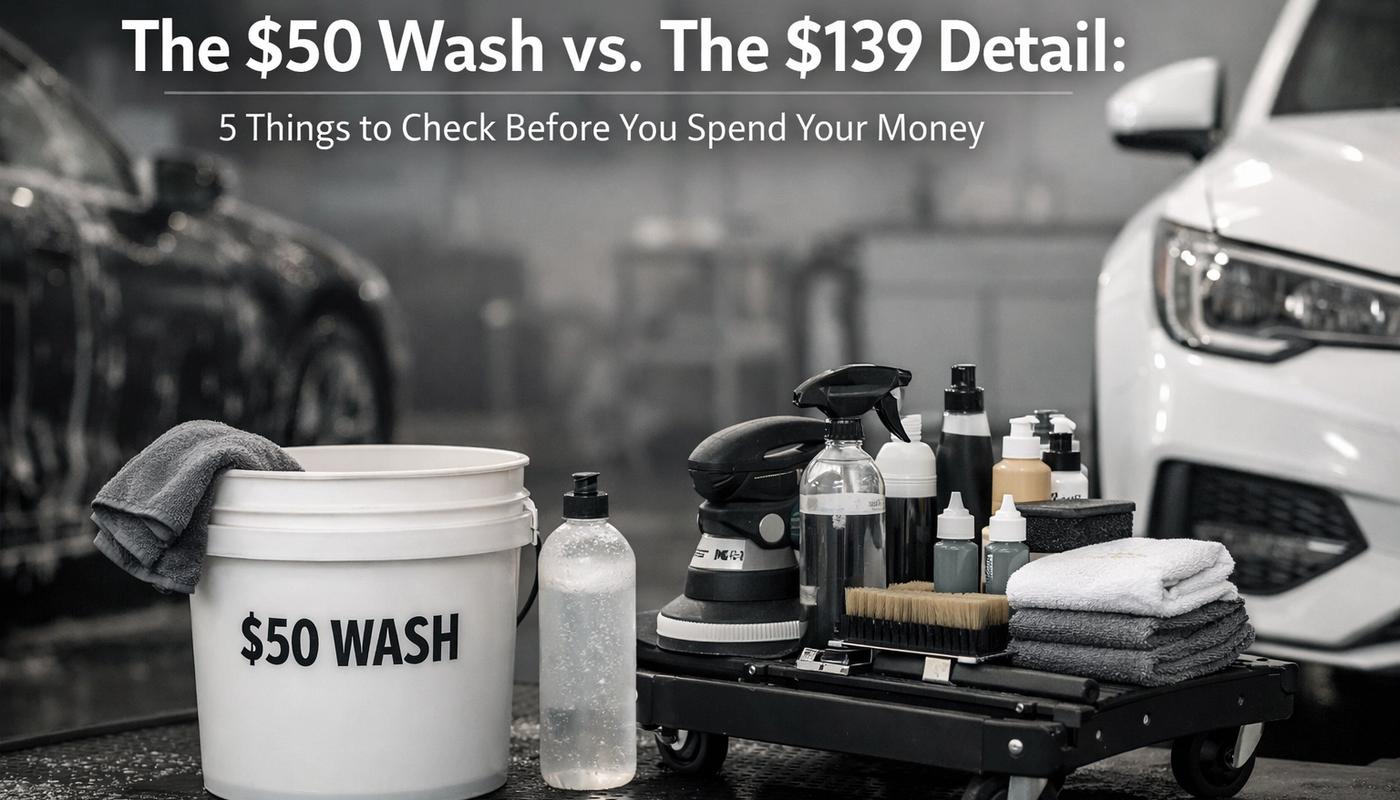
The $50 Wash vs. The $139 Detail: 5 Things to Check Before You Spend Your Money
You're standing in the parking lot, looking at your car. It's dirty. Salt-crusted. The interior has that... texture. You've got two options: the $50 express wash down the street, or the $139 professional detail.
Most people default to the cheaper option. Makes sense on the surface. But here's what most car owners don't realize: those two services aren't just different prices: they're entirely different categories of care.
One is maintenance. The other is protection.
Let's break down the five real differences that determine whether you're getting your money's worth or just... getting wet.
1. Hand-Washing vs. Machine Brushes (And Why Your Paint Cares)
The $50 wash runs your car through automated brushes that touch hundreds of vehicles per day. Those bristles collect debris: sand, road salt, metal particles: and drag them across your clear coat like 400-grit sandpaper.
Professional detailing uses the two-bucket hand-wash method. One bucket for soap, one for rinsing the mitt. This isn't just theater: it's the difference between microscratches that dull your paint over 12 months and a finish that still looks sharp three years in.
When you're paying $139 for mobile car detailing in NJ, you're paying for someone to treat your vehicle like it's their own. That means no automated machinery making contact with your paint. Period.
The compound effect matters here. Three trips through an automated wash equals roughly $150 spent: and your paint is worse off than if you'd invested in one proper detail.
2. Foam Pre-Soak: The Step That Prevents Damage
Here's where most cheap washes cut corners: they skip the pre-soak entirely.
A foam cannon isn't cosmetic. It lifts dirt, grime, and contaminants before any physical contact happens. This creates a barrier between the wash mitt and your paint, so you're not grinding particles into the surface during the wash.
The $50 wash? They spray water, hit you with soap, and go straight to scrubbing. That means every piece of road debris is being dragged across your hood, doors, and panels at high pressure.
Professional detailers foam the entire vehicle first, let it dwell for 3-5 minutes, then rinse before ever making contact. This single step reduces swirl marks and micro-scratching by roughly 70%.
If you're wondering why your black car looks hazy under sunlight after six months of "regular washing," this is why.
3. Wheel and Tire Detailing: The Difference Between Clean and Detailed
The $50 wash hits your wheels with a pressure washer and calls it done. Maybe they spray tire shine if you're lucky.
A $139 detail treats wheels as a separate project:
- Degreaser applied to break down brake dust
- Individual spoke cleaning with dedicated brushes
- Wheel wells scrubbed and rinsed
- Tires cleaned, then dressed with UV-protectant tire shine
Brake dust isn't just ugly: it's corrosive. Left untreated, it etches into your wheel finish and causes permanent staining. That's a $800+ refinishing job you're setting yourself up for by skipping proper wheel care.
For anyone getting car detailing in Morris County NJ, this is especially critical during winter months. Road salt accelerates corrosion on wheels faster than almost any other surface on your vehicle.
4. Trim and Plastic Care: Protection You Can't See (Until It's Gone)
Ever notice how black plastic trim on older cars turns gray and chalky? That's UV damage. And most washes don't touch it.
The $50 wash ignores trim entirely. Water hits it, soap touches it, but no one's protecting it.
Professional detailing includes trim restoration and protection:
- Cleaning with pH-balanced solutions
- UV protectant applied to rubber seals, plastic trim, and window moldings
- Tire sidewalls conditioned to prevent cracking
This isn't about aesthetics: it's about extending the life of components. Dried-out rubber seals let water into your cabin. Cracked trim looks terrible and costs $300+ to replace per panel.
When you pay for proper detailing, you're buying an insurance policy against preventable degradation.
5. Mobile Convenience: The Value of Your Time
The standard wash requires you to:
- Drive to the location (15 minutes)
- Wait in line (20 minutes on weekends)
- Sit through the wash (10 minutes)
- Drive home (15 minutes)
Total investment: $50 and 60+ minutes of your Saturday.
Mobile car detailing in NJ flips this model. A professional comes to your driveway or office parking lot while you're working, spending time with family, or literally doing anything else.
The math changes when you factor in convenience. If your time is worth $75/hour (a reasonable middle-class hourly rate), you just spent $125 in time and money for a wash that didn't actually protect your vehicle.
The $139 detail costs $14 more: and you got 60 minutes of your life back.
For business owners and professionals across Morris County, this isn't a luxury. It's basic time-value optimization.
The Long Game: Protection vs. Repetition
Here's the framework most people miss when comparing prices:
A $50 wash needs to be repeated every 2-3 weeks to maintain appearance. That's $800-$1,300 per year.
A professional $139 exterior detail provides protection that lasts 8-12 weeks, depending on conditions. If you detail four times per year, you're spending $556 annually: and your vehicle is in objectively better condition.
The cheap option feels affordable in the moment. But it's a subscription model disguised as savings.
You're not choosing between $50 and $139. You're choosing between surface maintenance and compound protection.
What Actually Matters For Your Car
Not every vehicle needs professional detailing every month. But here's the decision framework:
Go with the $50 wash if:
- Your car is less than a year old with minimal wear
- You're washing every 7-10 days regardless
- You genuinely don't care about resale value or paint condition
Invest in the $139 detail if:
- You want your car to hold its value
- You drive in winter conditions with road salt
- You park outside and deal with UV exposure
- You'd rather protect your investment than repair damage later
The goal isn't to upsell you. It's to make sure you understand what you're actually buying.
How ONIT Detailing Approaches the $139 Detail
We don't believe in nickel-and-diming services or creating confusion with package tiers. Our $139 exterior detail includes everything mentioned above: foam pre-soak, two-bucket hand wash, wheel and tire detailing, trim protection, and mobile service across Morris County.
No hidden fees. No upsells in your driveway. Just the service we promised when you booked.
You can check pricing and availability at our booking page, or explore what a professional detail actually looks like in our portfolio.
Most detailers will tell you what they do. We'd rather show you the difference between surface cleaning and actual protection: then let you decide if that's worth $89 more than a machine wash.
Your car is likely the second-largest purchase you'll ever make. Treating it like a $50 decision every two weeks adds up faster than a $139 investment every quarter.
The math works. The protection compounds. And you get your Saturdays back.